English
  Français
Canadian businesses face an unprecedented cybersecurity risks. According to the Canadian Centre for Cyber Security’s National Cyber Threat Assessment 2025-2026, state-sponsored and financially motivated cyber threats are increasingly targeting Canadians, with foreign actors moving beyond espionage to conduct more disruptive activities.
The question is no longer “if” your business will be targeted, but “when.” This guide examines the top 10 cybersecurity risks facing Canadian businesses in 2026 and provides actionable strategies to protect your organization.
What’s Included
Major Cybersecurity Risks To Look Out
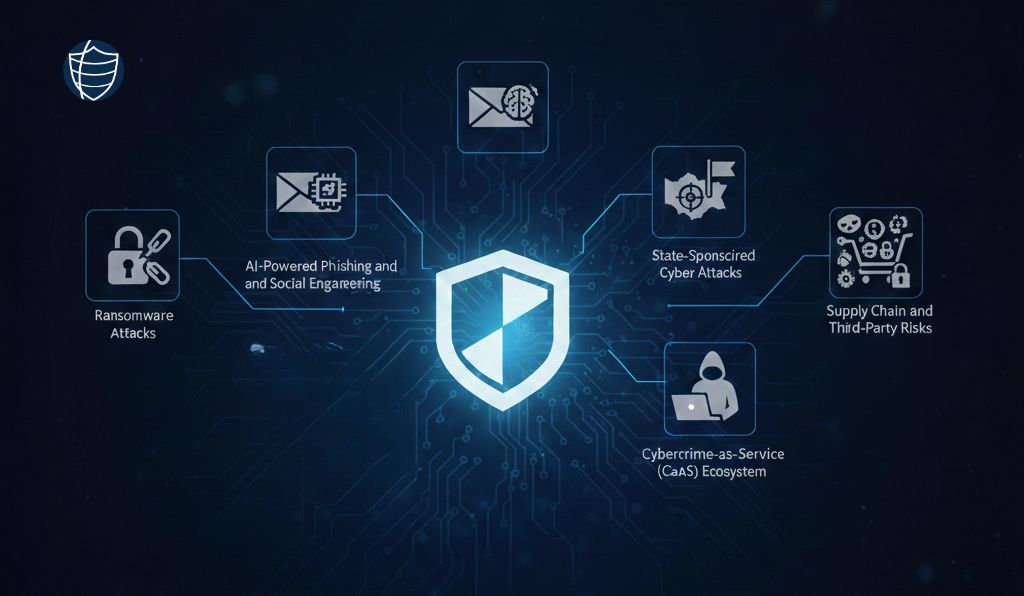
1. Ransomware Attacks
Ransomware is the top cybersecurity risks for Canada’s critical infrastructure. In 2026, ransomware has evolved from simple encryption attacks to sophisticated multi-stage operations that combine data theft, extortion, and business disruption.
Average ransom payouts in Canada reached $1.13 million in 2023, and these numbers continue to climb as attackers escalate their tactics.
How Ransomware Attacks Work in 2026
- Modern ransomware attacks usually follow a clear lifecycle:
- Initial Access: Phishing emails, exploited vulnerabilities, or stolen credentials
- Lateral Movement: Malware spreads to locate high-value systems and data
- Data Exfiltration: Sensitive data is stolen before any encryption
- Encryption: Files and systems are locked, disrupting operations
- Triple Extortion: Attackers demand ransom, threaten data leaks, and may launch DDoS attacks
Real Canadian Ransomware Incidents
- London Drugs (April 2024):
LockBit forced all 79 stores to shut down for over a week after stealing employee data. A $25M ransom was demanded and refused, resulting in major revenue loss and system rebuilds. LockBit forced all 79 stores to shut down for over a week after stealing employee data. A $25M ransom was demanded and refused, resulting in major revenue loss and system rebuilds.
- Nova Scotia Power (March 2025):
A ransomware breach exposed personal and financial data of nearly 280,000 customers, highlighting risks to critical infrastructure.
- Toronto Public Library (October 2023):
A Black Basta attack crippled digital services for months, exposing decades of employee data and leaving over one million books inaccessible. The ransom was not paid.
- Hospital for Sick Children (December 2022):
LockBit disrupted critical hospital systems, delaying care and payroll. The attackers later issued an apology and provided a free decryptor.
2. AI-Powered Phishing and Social Engineering
Phishing has undergone a dramatic transformation in 2026. The National Cyber Threat Assessment 2025-2026 documented that cybercriminals and state-sponsored actors are using generative AI to make social engineering attacks more personal and persuasive.
AI-enabled phishing content is expected to drive a notable rise in social engineering attacks through 2026. Today’s AI-powered attacks include:
1. Hyper-Personalized Phishing Emails
- AI scrapes social media and public data to create contextually relevant messages
- Perfect grammar and professional formatting eliminate traditional warning signs
- Emails mimic legitimate business communications with uncanny accuracy
2. Deepfake Voice and Video Attacks
Deepfake voice and video attacks use AI to replicate the appearance and voice of real individuals, often executives or trusted employees, using publicly available audio and video recordings. Attackers leverage these synthetic identities during phone calls or video meetings to deliver urgent or authoritative requests that appear legitimate. These attacks are particularly effective because they bypass traditional security awareness cues. Instead of suspicious links or emails, employees are confronted with familiar faces and voices, making real-time verification difficult under pressure.
A real-world demonstration of how convincing these attacks can be is shown in this video example: https://youtu.be/W8fbKYjbFD4?si=RIpSf60BRWrvn0ux
3. Business Email Compromise (BEC):
Business email breach (BEC) happens when attackers imitate trusted leaders and deceive employees into transmitting money or data. These frauds cost firms millions of dollars, and many small businesses are unable to recover their losses. According to Verizon Data Breach Report of 2025, 58% of financially motivated phishing attacks were BEC-related. Meanwhile according to Arctic Wolf Threat report, average initial loss in phishing-based BEC incidents exceeded $160,000 before recovery.
Real-World Examples of AI-Enhanced Attacks
NioCorp Developments (Canada,2025):
Attackers compromised email accounts and redirected a legitimate vendor payment, resulting in a $500,000 loss and highlighting supply-chain trust abuse.
$25M Deepfake BEC (Hong Kong, 2024):
A finance employee was deceived into transferring $25 million after joining a video call featuring AI-generated deepfake executives, including the company’s CFO.
RedVDS Platform (Microsoft, 2026) :
A subscription-based cybercrime service dismantled by Microsoft, linked to over $40M in losses. It enabled phishing campaigns using AI deepfake video and voice impersonation, with Canada among the hardest-hit regions. A subscription-based cybercrime service dismantled by Microsoft, linked to over $40M in losses. It enabled phishing campaigns using AI deepfake video and voice impersonation, with Canada among the hardest-hit regions.
3. State-Sponsored Cyber Attacks
State-sponsored cyber-attacks are cyber operations launched by governments or state-affiliated enterprises with the goal of accomplishing political, economic, or military objectives. These attacks are frequently complex and well-funded, employing modern technologies and resources. They can target a variety of sectors, including government institutions, key infrastructure, military systems, corporations, and individuals.
Real-World Examples of State Sponsored Cyber Attacks
- U.S. Congressional Budget Office Incident (Nov 2025): A cyber incident at the U.S. Congressional Budget Office exposed communications between the CBO and Senate offices, prompting containment actions and warnings of targeted phishing risks tied to suspected foreign actors.
- Ransomware Disrupts U.S. Emergency Alerts (Nov 2025): The Inc Ransom group targeted the CodeRED emergency alert platform used by dozens of U.S. local governments, disrupting the ability to send public safety notifications and leading to a breach of user contact data.
- Phishing Campaign Targeting Russian Government (Early 2025): The Tomiris threat actor launched a sophisticated spear-phishing campaign against Russian government officials and organizations, using advanced implants and social engineering to evade detection.
- AI Deepfake Social Engineering Against South Korea (Jul 2025): A state-linked group allegedly used AI-generated deepfake images in spear-phishing targeting South Korean defense-related organizations, aiming to trick recipients into engaging with malicious links.
4. Cybercrime-as-a-Service (CaaS) Ecosystem
The Cybercrime-as-a-Service business model is almost certainly contributing to the continued resilience of cybercrime in Canada and around the world.
The CaaS ecosystem operates like legitimate software-as-a-service businesses:
- Ransomware-as-a-Service (RaaS): Pre-built ransomware with affiliate programs
- Phishing-as-a-Service (PhaaS): Ready-made phishing kits and infrastructure
- DDoS-as-a-Service: On-demand distributed denial-of-service attacks
- Credential Markets: Stolen login information sold on dark web marketplaces
Real Canadian Impacts
- STAC6565 / Gold Blade (2024–2025): This threat group carried out nearly 40 intrusions, with 80% targeting Canadian companies, using fake resumes on job sites to deliver QWCrypt ransomware.
- LockBit in Canada: Before law-enforcement disruption, LockBit accounted for 22% of ransomware attacks in Canada and over 40% globally. Despite a 2024 takedown, the group continued targeting Canadian organizations, including the $25M London Drugs attack.
5. Supply Chain and Third-Party Risks
These cascading attacks occur when an initial supply chain breach enables further downstream compromises.
Why Supply Chains Are Targeted
Attackers target supply chains because:
- One breach can compromise hundreds or thousands of organizations
- Smaller vendors often have weaker security
- Trust relationships allow attackers to bypass security controls
- Detection is more difficult across organizational boundaries
Types of Supply Chain Attacks
Software Supply Chain Compromises
In September 2024, Brookfield Global Relocation Services, a private company supporting Canadian military and foreign service personnel, suffered unauthorized access to its systems. The breach exposed sensitive information related to individuals serving Canada’s national security interests, highlighting how deeply software vendors can be embedded in critical government operations.
This type of incident is often the result of software supply chain compromises, where attackers infiltrate trusted software vendors rather than targeting end organizations directly. Nation-state actors are known to compromise development environments, build systems, or SDKs, inserting backdoors that are unknowingly distributed to customers through legitimate software updates. Once deployed, these backdoors provide attackers with widespread and persistent access across multiple organizations.
Similar attacks have been observed globally, where a single compromised vendor enables attackers to scale access across hundreds or thousands of downstream customers.
Third-Party Service Provider Breaches
In March 2024, Black & McDonald, a major Canadian engineering and infrastructure services company working on military bases and electricity generation facilities, was hit by a ransomware attack. While the company itself was the direct victim, the incident underscored how contractors and service providers can become gateways into critical infrastructure environments.
These incidents often stem from third-party service provider breaches, where organizations rely on external vendors, managed services, or open-source components without full visibility into their security posture. Developers frequently use libraries from package managers such as npm or pip, and vulnerabilities in these dependencies can persist unnoticed for long periods. Without proper inventory, monitoring, and patch management, organizations may unknowingly inherit risk from their suppliers.
Attackers increasingly exploit this trust relationship, knowing that compromising one vendor can expose multiple clients.
Hardware Supply Chain Infiltration
In 2024, Trans-Northern Pipelines Inc., an Ontario-based energy transportation company, was reportedly targeted by the ALPHV ransomware group. Attacks on organizations supporting energy infrastructure demonstrate how supply chain compromises can have downstream effects on essential services.
While many supply chain attacks focus on software, hardware and firmware compromises represent an even more persistent threat. Malicious modifications to hardware components, embedded firmware, or network devices can provide long-term access that is difficult to detect or remediate. Once deployed, these compromised components may operate below the visibility of traditional security controls.
Globally, hardware supply chain risks have raised serious concerns for governments and critical infrastructure operators, as remediation often requires physical replacement rather than simple patching.
Building a Comprehensive Cybersecurity Strategy for 2026
What Matters Most
- Understand Your Risk: Identify critical systems, assess weaknesses, and focus on the most likely and damaging threats.
- Use Proven Frameworks: Align security efforts with standards like NIST, ISO 27001, or CIS Controls.
- Defend in Layers: Secure networks, endpoints, email, cloud environments, identities, and sensitive data.
- Be Ready to Respond: Maintain a clear incident response plan with defined roles, communication steps, and regular testing.
- Continuously Improve: Monitor threats, test defenses, measure performance, and adapt as risks evolv
The Canadian Context
While the Canadian government has committed $917.4 million to strengthen national cyber capabilities, organizations remain accountable for protecting their own environments. Building internal skills through recognized security training and certifications is essential.
What Canadian Businesses Should Know in 2026
- Ransomware remains the most disruptive threat
- AI has made phishing and social engineering far more convincing
- State-sponsored attackers continue to target Canadian organizations
- Cloud and supply-chain risks are growing
- People remain both the weakest link and the strongest defense
- Cybersecurity is a core business responsibility
Final words,
Cybersecurity in 2026 is no longer optional. It’s a business-critical requirement. Threats are evolving faster than internal teams can keep up, and gaps in strategy, response, or visibility can quickly turn into costly incidents.
Data Next Step helps businesses turn cybersecurity from a risk into a strength. Our experts work with you to assess risk, strengthen defenses, improve incident readiness, and align security with business goals, not just compliance checklists.
Whether you need a cyber risk assessment, incident response planning, cloud and identity security, or ongoing advisory support, we’re here to guide you every step of the way.
Book a cybersecurity consultation with Data Next Step to evaluate your current posture, identify priority gaps, and build a practical, future-ready security strategy for your business.